Begin with the crop and stage
A lighting plan starts with what is growing and what you expect it to do. Germinating seedlings, compact herbs, leafy greens and fruiting crops do not share one useful target. A basil plant being held through winter also has a different job from a tomato expected to flower and fruit indoors.
University of Minnesota Extension groups indoor conditions into broad low-, medium- and high-light ranges and explains that seedlings and food crops usually need supplemental light indoors. University of New Hampshire Extension notes that winter windows often deliver too little total light even for lettuce at a practical growth rate. The first useful question is therefore not “How many watts?” It is “What crop, at what stage, over what bench area?”
Write the crop list, canopy dimensions and goal before reading fixture claims. If the goal changes from keeping herbs alive to producing repeated harvests, the useful light requirement changes too.
Learn the four numbers without turning the bench into a laboratory
Photosynthetic photon flux describes the plant-usable light a fixture emits each second. It is a fixture-output number, not proof of what reaches the crop.
Photosynthetic photon flux density describes the plant-usable light arriving at a surface. Measure it at leaf height across the bench.
The number of light hours in each 24-hour day. A timer makes this repeatable and preserves a dark period.
Daily light integral combines intensity and time into the total plant-usable light delivered each day.
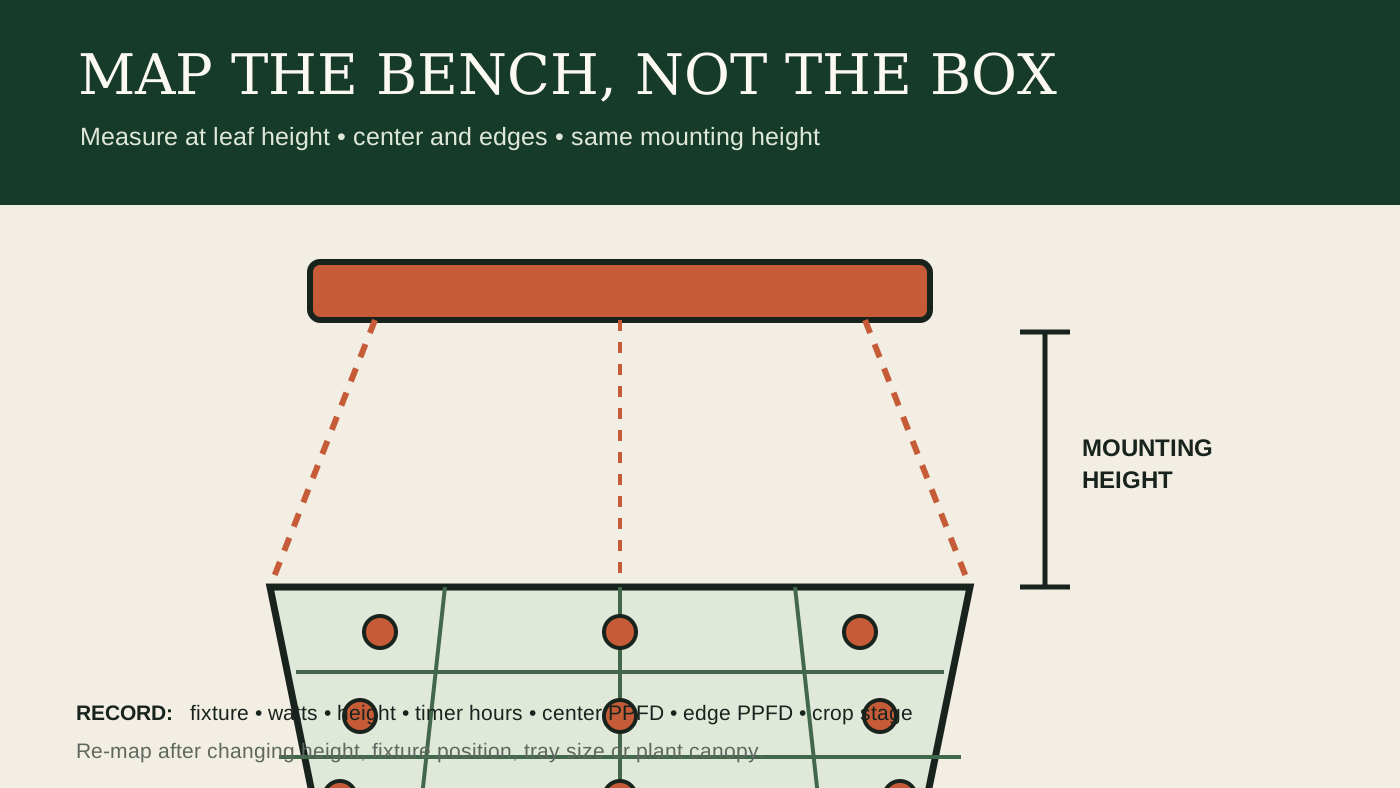
PPFD falls as plants move farther from the fixture, and the center is commonly brighter than the edges. A single center reading can make a fixture appear better matched than the whole tray really is. A published coverage claim is only useful when it states the mounting height, measurement method and intensity across that area.
Map a nine-point bench
- Set the real geometry. Install the fixture at the maker’s permitted height over the exact tray or shelf. Measure from the light-emitting surface to the top leaves, not to the floor.
- Mark nine points. Use the four corners, four side midpoints and center. For a long shelf, add enough points to reveal the ends and any gap between fixtures.
- Measure at canopy height. Keep the sensor level and oriented as its instructions require. Record every point without moving the fixture.
- Find the weak area. Compare edge and corner readings with the center. The usable footprint is the area that meets the crop plan, not the area touched by visible light.
- Record the setup. Write fixture, actual wall watts, mounting height, timer hours, crop stage and measurement date. Photograph the layout so it can be reproduced.
A calibrated quantum sensor is the appropriate tool for PPFD. A phone application may help compare relative patterns, but phone sensors and calibration vary; do not treat an unverified app reading as laboratory accuracy. The useful low-cost experiment is consistency: use the same device, position and method to see how height and placement change the pattern.
Turn intensity and time into daily light
DLI is calculated from average PPFD and the number of seconds the lights run:
For example, an average PPFD of 200 micromoles per square meter per second for 14 hours gives about 10.1 moles per square meter per day. This calculation is a planning estimate when PPFD varies across the canopy or sunlight also reaches the plants. Average several representative readings rather than using only the bright center.
UNH Extension emphasizes that quantity, expressed as DLI, often matters more than the marketing color of the lamp. Its seedling guidance shows why fixture strength, mounting distance and runtime trade against one another: a weaker or more distant lamp may need an impractically long day to deliver the target. No timer can create more than 24 hours, and plants still need an appropriate dark period.
Use the timer as a control, not a cure
University of Minnesota suggests total daily light periods of roughly 16–18 hours for seedlings and 12–14 hours for hydroponic lettuce and herbs, while also noting that crop type and flowering response matter. Utah State recommends 12–14 or more hours for actively growing vegetable seedlings. These are starting ranges, not substitutes for measuring crop response and daily light.
Longer runtime raises energy use and may raise shelf temperature. It cannot correct a dark edge if the fixture footprint misses half the tray. Adjust in this order:
- Center the canopy under the measured footprint.
- Set the fixture at a safe, permitted height that improves uniformity.
- Reduce unused bench area or group crops with similar needs.
- Set a consistent photoperiod with a timer.
- Add or replace a fixture only when the mapped system still cannot meet the goal.
Do not run a fixture closer than its instructions allow. Heat at the leaf surface, water near electrical equipment and mounting stability remain part of the system.
Read a product label like a grower
| Claim | What to request | Why it matters |
|---|---|---|
| “Covers 2 × 4 feet” | PPFD map, mounting height and measurement grid | Visible light can extend beyond useful crop intensity |
| “100 watts” | Actual input watts and PPF or mapped PPFD | Watts are energy input, not light at the leaf |
| “Full spectrum” | Spectral chart and intended crop stage | The phrase alone says little about quantity or coverage |
| “Dimmable” | Output at each setting and control compatibility | Dimming changes intensity and may change uniformity |
| “Water resistant” | Exact rating, permitted location and cleaning instructions | Indoor growing combines water, humidity and electricity |
| “Long life” | Rated life conditions, warranty and replaceable driver details | Heat and serviceability affect the useful life of the system |
Keep checkout, prices and branded claims out of the decision until a supplier confirms authorization, current specifications, warranty handling, inventory and safe-use documentation. A technically useful listing should publish the conditions behind its coverage claim.
Diagnose plants with measurements and context
Long internodes, pale growth and leaning toward the fixture can indicate too little light. Bleached or scorched tissue can indicate excessive intensity, heat or both. Extension guidance also warns that temperature, water, nutrition and airflow can create similar symptoms. Do not solve every weak seedling by moving the light closer.
Change one variable at a time and log it. Record height, timer schedule, center and edge readings, watering frequency, temperature and visible response. Give the crop time to show a pattern. If only the edge plants stretch, coverage is more likely than total runtime. If the entire tray is weak, investigate intensity, duration, temperature, roots and nutrition together.
Run a seven-day fit test
At day seven, compare the plant response across the grid. Rotate trays only if rotation is part of the permanent routine; otherwise it can hide a poor footprint. Re-map whenever the fixture height, tray size, plant height or shelf arrangement changes.
Sources checked
- University of Minnesota Extension: Lighting for Indoor Plants and Starting Seeds, reviewed 2026.
- University of New Hampshire Extension: Growing Seedlings Under Lights.
- University of New Hampshire Extension: Hydroponics at Home.
- Utah State University Extension: Starting Vegetable Seeds Indoors—Seedling Culture and Transplanting.
- University of New Hampshire Extension: Growing Vegetables in Containers.
Research reviewed September 28, 2026. Follow current fixture instructions and applicable electrical requirements.