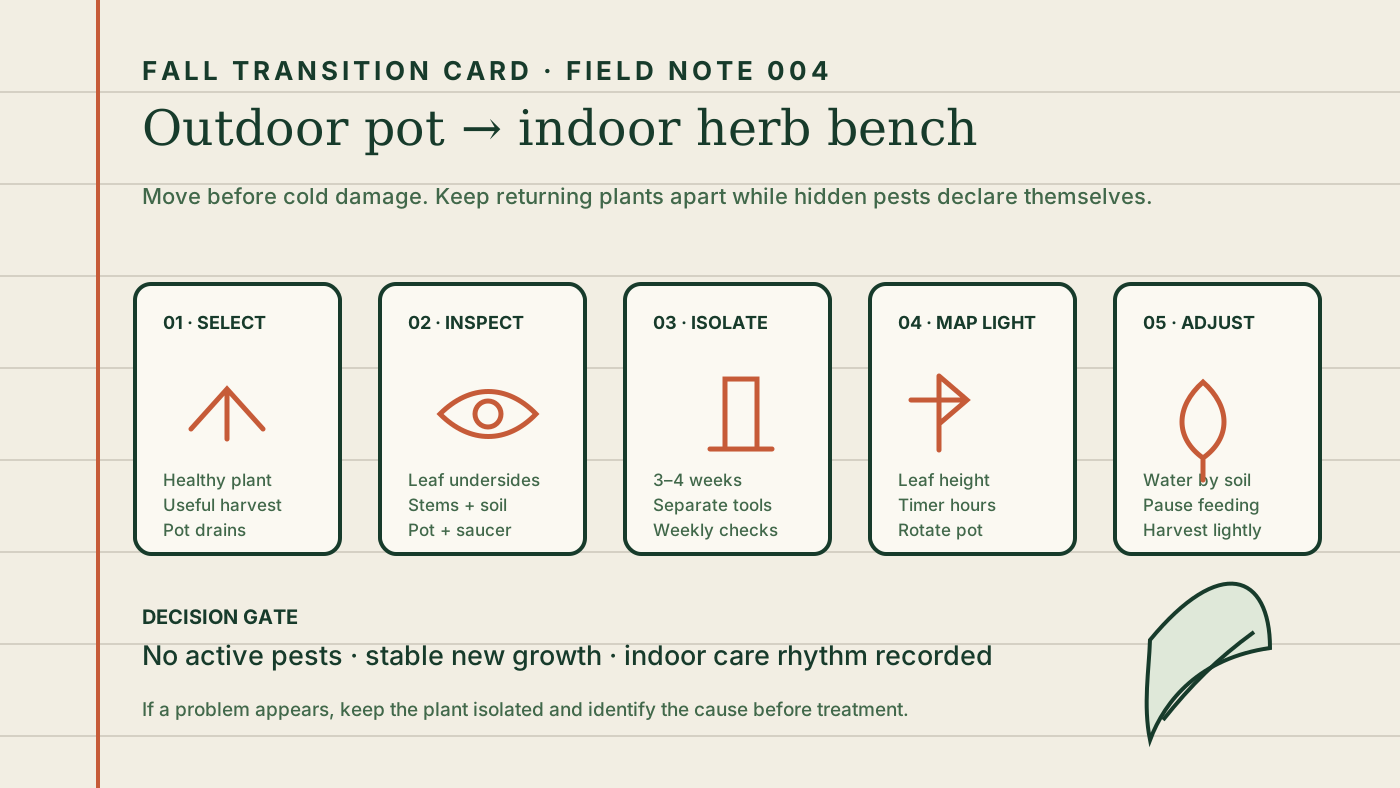
First decide what is worth moving
The cheapest winter herb setup is not the one that saves every pot. It is the one that gives a few healthy, frequently used herbs enough light and attention to remain useful. A crowded indoor bench makes inspection harder, slows airflow, and lets one overlooked pest spread across the collection.
Begin with a simple question: will this particular plant earn its indoor space? Perennial container herbs such as rosemary, bay, thyme, oregano, chives, mint, and sage may be reasonable candidates when healthy and manageable. Tender basil can grow indoors, but a large outdoor basil plant that has already flowered, suffered cold, or carries disease may be less useful than clean cuttings or a new sowing. Cilantro and parsley can be grown indoors, yet their life cycles and root systems make “save the old patio pot” a different decision from “start a winter crop.”
| Plant condition | Practical choice | Reason |
|---|---|---|
| Healthy, compact, clean perennial in a draining pot | Prepare for transition | It has a realistic chance of adapting to indoor light and slower growth |
| Large healthy plant but no room for its canopy | Take clean cuttings or divide when the species and season suit it | A smaller start may fit the winter bench and is easier to inspect |
| Heavy infestation, stem rot, root trouble, or spreading disease | Do not move it beside indoor plants | The value of one herb rarely justifies exposing an established collection |
| Annual near the end of its useful cycle | Harvest and preserve, or sow a clean replacement | Indoor space should match likely winter yield |
| Unknown herb or uncertain pet safety | Identify it before choosing a room | Plant identity affects care, harvest, and household placement |
Keep individual herbs in individual pots during the transition when possible. Separate containers make it easier to isolate one problem, adjust water by species, rotate plants, and remove a pot without disturbing a mixed planter. Every container needs an open drainage hole and a saucer that does not leave the root zone standing in water.
Build a transition station before carrying plants inside
The quarantine area should be physically apart from established houseplants. A separate room is easiest. If that is impossible, use the greatest practical distance and do not let leaves touch. Keep returning pots off the main plant shelf, and avoid sharing saucers, pruning tools, watering cans, or spilled potting mix between the groups.
The station needs less gear than many shopping lists imply:
- a washable surface with enough room to inspect every side of a pot;
- a bright window or a measured supplemental light position;
- a saucer or drain tray for each pot;
- a clean pruner, paper towels, and a waste bag for removed material;
- a hand lens or phone magnifier for very small pests;
- yellow or blue sticky cards used as monitoring tools rather than a complete treatment;
- a notebook with the move date, plant name, pest observations, watering, and new growth.
A decorative cachepot can wait. During quarantine, the pot rim, drainage holes, soil surface, and saucer all need to stay visible. If you use a grow light, record its mounting height and timer hours rather than trusting an “equivalent” wattage claim. The site’s grow-light coverage guide explains how to check the center and edges at leaf height.
One to two weeks outside: reduce the shock
Penn State’s September 2026 guidance recommends gradually reducing light for roughly one to two weeks when possible. That does not mean placing a sun-loving herb immediately into a dark corner. It means narrowing the difference between the outdoor position and the indoor destination while weather still allows time to observe the response.
- Choose the indoor destination. Measure the open footprint, window exposure, temperature swings, and distance from heating vents before moving a pot.
- Check forecast lows daily. Cold-sensitive herbs may need an earlier move. Do not sacrifice the plant to complete an ideal acclimation calendar.
- Shift light gradually. Move a full-sun container toward filtered outdoor light over several days, while watching for stretch, yellowing, or stress.
- Trim only what is justified. Remove dead, diseased, or badly damaged material. Avoid a severe haircut merely to make an unhealthy plant look tidy.
- Reset the watering decision. Check moisture rather than repeating the outdoor schedule. Cooler temperatures and less light can lengthen the interval.
Some leaf yellowing or drop can follow the move even when no pest is present. Penn State notes that plants may take one or two months to adjust to new indoor conditions. The quarantine log helps separate a transition response from a problem that is multiplying.
Inspection day: use a route, not a glance
A quick look from above misses the places where small insects hide. University of Minnesota Extension recommends checking leaf tops and undersides, discolored tissue, webbing, holes, eggs, sticky honeydew, pot rims, crevices, bottoms, and saucers. Work in the same order every time so the inspection is repeatable.
- Read the overall shape. Look for uneven vigor, distorted tips, premature leaf drop, and a branch that differs from the rest.
- Turn over several leaves. Include young growth and leaves near the pot rim. Check for aphids, mites, thrips, whiteflies, scale, eggs, shed skins, and webbing.
- Follow every stem. Examine leaf joints and woody crevices. Cottony material and fixed bumps deserve a closer look.
- Look down. Inspect the media surface, drainage holes, outside wall, rim, and saucer. Notice crawling insects, slugs, egg masses, and persistent fungus gnat activity.
- Touch nothing else yet. Bag removed leaves and clean the work surface and tools before the next plant.
A strong rinse can physically remove many pests from leaves and stems. Penn State also describes soaking a houseplant pot to the rim in lukewarm water for at least 15 minutes to flush insects from the soil, followed by complete draining and drying. That advice must be applied carefully to a sound, well-drained container; do not turn a waterlogged or root-diseased herb into a longer soak. Never submerge edible foliage in a mystery cleaner or improvise a pesticide mixture from household products.
Weeks 1–4: quarantine is active monitoring
Penn State recommends keeping plants returning indoors apart for three to four weeks. University of Minnesota gives a shorter general isolation minimum for new indoor plants, but the longer returning-plant window is a sensible plan for this patio transition because outdoor pots have had sustained exposure. Quarantine is not a pot placed in a corner and forgotten. It is a scheduled series of inspections.
| Week | What to do | What unlocks the next step |
|---|---|---|
| Move day | Photograph leaves and stems, inspect the whole route, rinse when appropriate, clean the pot exterior, place separately | No obvious heavy infestation or advancing disease |
| Week 1 | Check new growth, undersides, sticky residue, webbing, soil surface, sticky cards, and drain behavior | No increasing pest signs; watering interval recorded |
| Week 2 | Repeat inspection under bright light; compare with move-day photos; rotate the pot for even exposure | Stable foliage and no unexplained damage pattern |
| Week 3 | Inspect pot crevices and leaf joints again; review light and temperature log | No active pest evidence and plant is adapting |
| Week 4 | Complete a final whole-plant check and clean the saucer and work area | Healthy new growth, no active pests, and a workable care rhythm |
If you find a problem in week three, the calendar does not certify the plant in week four. Keep it isolated, identify the pest or disease, and restart observation after control. Moving a plant because the original date arrived defeats the point of the process.
Identify before treating an edible plant
Start with the least disruptive actions that fit the pest: isolation, pruning a limited infested tip, rinsing leaf surfaces, cleaning honeydew, removing debris, and correcting care that favors fungus gnats or rot. A sticky card can reveal flying adults, but it will not remove eggs, larvae, or fixed insects from the plant.
If those steps are not enough, identify the pest before choosing a product. The phrase “natural spray” does not establish that a product is safe or legal for every use. For herbs that will be eaten, the label must cover the specific edible crop or crop group, the target pest, the indoor site, application method, and any time required before harvest. The U.S. Environmental Protection Agency says to read the label first, follow all precautions and restrictions, never use a product for an unlisted pest, and never use more than directed. Remove or cover food during indoor applications and keep people and pets away as the label requires.
- Can you name the pest, or do you only see symptoms?
- Does the label name this edible herb or an applicable crop group?
- Does it allow indoor use in this setting?
- Does it list the target pest and a harvest interval?
- Can you follow ventilation, protective equipment, surface protection, and re-entry directions?
If any answer is unclear, keep the plant isolated and ask a local Extension office or the product manufacturer. Do not infer permission from the active ingredient alone.
Map winter light at the leaves
Most herbs need a bright position. Penn State lists bay, rosemary, and thyme among herbs that do best with direct sunlight, while chives, cilantro, and lemon balm tolerate less. Illinois Extension notes that winter windows may require supplemental lighting and that indoor herbs often grow more slowly even under good conditions.
Window direction is only a starting clue. Nearby buildings, trees, screens, deep eaves, dirty glass, and the plant’s distance from the pane all change usable light. A cold-sensitive basil should not be pressed against freezing glass simply because the window faces south. Record the real position:
- hours of direct window sun at the leaf surface;
- supplemental-light hours and fixture height;
- center and edge readings if you use a meter;
- day and night temperatures beside the foliage;
- weekly stem stretch, leaf size, and pot rotation.
Do not run a light continuously. Plants need a dark period. Use the fixture’s published instructions and crop guidance, then assess the plant. Thin stretched stems, small leaves, and reduced aroma can signal inadequate light. Bleaching, scorching, or excessive heat calls for a different diagnosis, not automatically more water.
Replace the outdoor watering calendar
The same pot can remain wet much longer indoors because light, air movement, temperature, and growth have changed. Penn State’s transition guidance says slower indoor growth generally means less water. Illinois Extension’s container guidance advises watering based on dryness and maintaining drainage. These ideas fit together: check the actual root zone, water thoroughly when the herb needs it, let excess drain, and do not leave the pot sitting in runoff.
Different herbs still need different thresholds. Rosemary, thyme, oregano, sage, bay, and marjoram are generally allowed to dry somewhat between waterings; basil should not be allowed to dry completely. Pot size, medium, root mass, and room conditions modify every interval. A written “every Tuesday” rule cannot see those differences.
Use pot weight as a second signal. After a thorough watering and complete drainage, note the weight by hand or on an appropriate scale. Compare it over several days while also checking the medium. The useful result is not a universal number; it is a repeatable reference for this plant in this pot and room.
Feed and harvest at the speed of new growth
Do not fertilize a stressed plant merely because it moved indoors. Penn State’s 2026 transition article says fertilizer is generally unnecessary while plants are not actively producing new growth. Once a healthy herb is established and growing, follow current crop guidance and the fertilizer label. Overfeeding herbs can reduce aroma and flavor, and fertilizer cannot compensate for weak light or damaged roots.
Harvest lightly until growth proves the plant has adapted. Cut cleanly at the appropriate node or stem position for the species rather than repeatedly stripping individual leaves from a plant that is not replacing them. Continue removing dead material promptly, and keep edible leaves clear of sticky-card adhesive and treatment residue.
A small-space decision card
Healthy compact perennial, good drainage, high household use, enough quarantine space, and a measured bright position.
Healthy parent but oversized canopy, suitable species, clean tools, and enough time to root before the parent declines.
Annual near the end of its cycle, poor indoor fit, or a cleaner new sowing offers a better use of the bench.
Severe infestation, advancing disease, rotted roots, or a problem that threatens established indoor plants.
This decision card is more useful than a cart full of unverified accessories. Eco Grow Essentials keeps prices, inventory, branded listings, checkout, and availability disabled until supplier authorization and current commercial terms are documented. Use the field-kit preview to compare functions and specifications, then choose only the tools your measured setup requires.
Frequently asked questions
How long should outdoor herbs stay quarantined?
Plan on three to four weeks, following Penn State’s current transition guidance. Inspect throughout the period. If you discover pests, keep the plant isolated until the problem is identified, controlled, and no longer active.
Should I repot every herb before bringing it indoors?
No. Unnecessary repotting adds root disturbance during an already large environmental change. Repot when the plant has a real container or drainage problem, and use a clean, well-drained potting mix appropriate for the herb. Do not bring garden soil indoors as a general potting medium.
Can I put herbs directly on the kitchen windowsill?
Only after you check light, temperature, space, and quarantine. A windowsill can be cold at night, hot in direct sun, or too narrow for drainage. Keep returning plants apart from established plants first, and keep pots away from food-preparation surfaces where soil, water, or any treatment could contaminate food.
Sources checked
- Penn State Extension — Before the First Frost: Bringing Your Plants Indoors for Winter, updated September 24, 2026.
- University of Minnesota Extension — Bringing Houseplants in for Winter, published September 10, 2026.
- University of Minnesota Extension — Managing Insects on Indoor Plants, reviewed 2026.
- Penn State Extension — Pest and Disease Problems of Indoor Plants, updated October 12, 2026.
- Penn State Extension — Growing Herbs Indoors, updated November 1, 2024.
- University of Illinois Extension — Keep Growing with Herbs Indoors This Fall, Winter.
- U.S. Environmental Protection Agency — Pesticide Safety Tips.
Research reviewed October 13, 2026. Plant identity, local climate, label directions, and household conditions should guide the final decision.