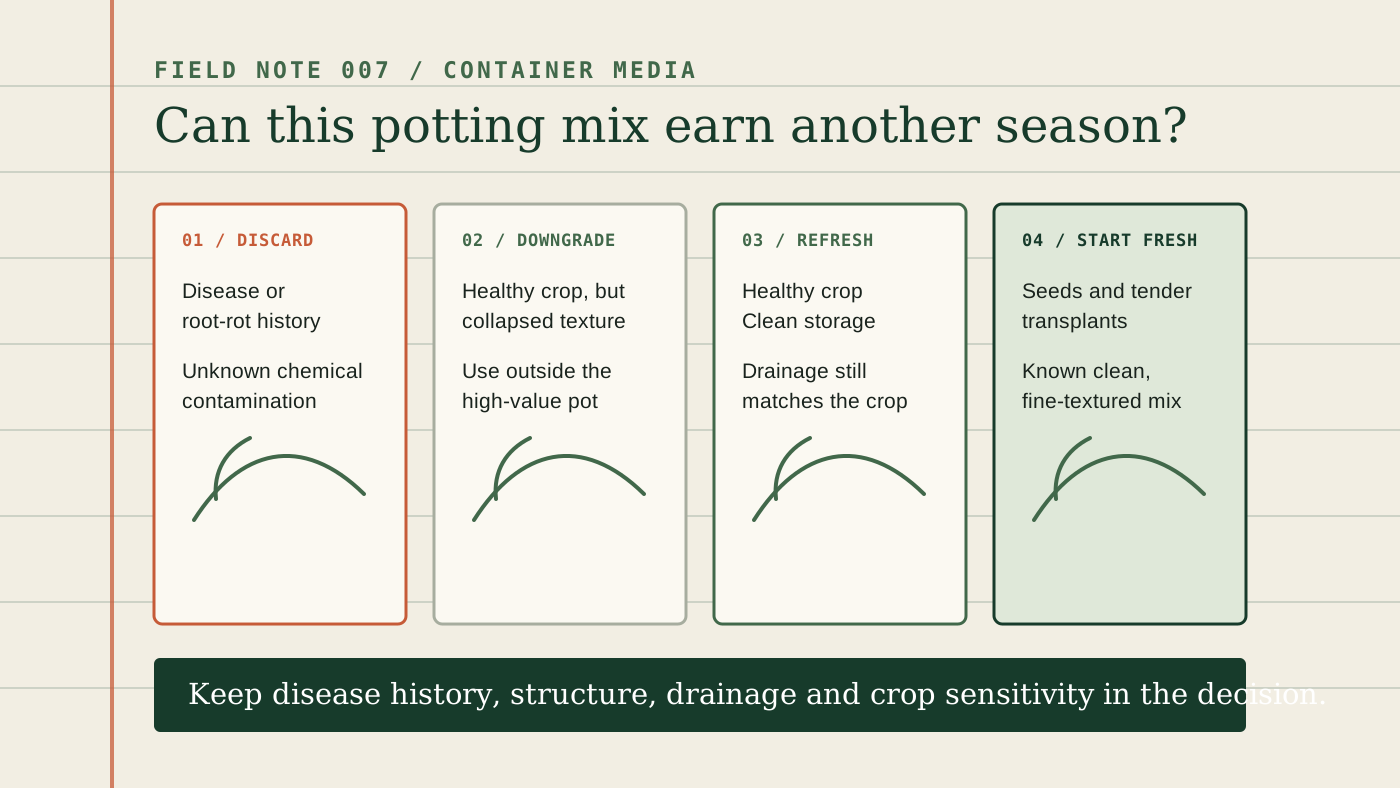
Autumn container cleanup produces a familiar pile: expensive potting mix threaded with roots, still light enough to handle, and apparently too useful to throw away. Search results and public gardening discussions often offer a simple answer—add compost, add fertilizer, bake it, solarize it or replace half. The useful answer is more conditional.
University of Illinois Extension says last year’s potting soil can be reused when the previous plants were healthy and disease-free, while noting that nutrients will be depleted. University of New Hampshire Extension adds two practical cautions: soilborne disease may remain after a crop, and old mix can become crowded with roots. Penn State Extension emphasizes that young transplants need clean media with appropriate drainage, aeration and soluble-salt levels. Together, those points suggest a four-bin triage instead of one amendment formula.
Bin 1: discard mix with a disease or contamination history
Do not reuse media from a container where plants developed unexplained wilt, damping-off, crown or root rot, severe stunting, galls, or a confirmed soilborne disease. Penn State lists Pythium, Phytophthora, Fusarium, Rhizoctonia, nematodes and other pathogens as possible residents of infested soil and media. A new plant can stimulate remaining organisms into activity.
Also discard mix exposed to a spilled pesticide, herbicide, fuel, paint, deicing salt, floodwater, animal waste, or an unknown chemical. Do not try to dilute an unidentified contaminant into a larger batch. Keep it out of food-growing containers and follow local waste guidance. If the original crop failed for an unknown reason, diagnosis is more valuable than optimistic reuse.
Do not count on a home oven or a casual clear-plastic bag to make suspect mix equivalent to new. Heat treatment must reach and hold appropriate conditions throughout the material, and it still does not restore pore space, remove salts or identify chemical residues. For a few household containers, replacing suspect mix is usually the simpler control.
Bin 2: downgrade healthy mix that has lost its job fit
Healthy history is necessary, but not sufficient. A mix can be free of obvious disease and still be a poor choice for the next container. Fine particles settle, roots occupy pore space, wetting behavior changes, and repeated watering alters the nutrient supply. If water ponds for a long time, the mass stays soggy, or the mix has shrunk into a dense root-bound plug, do not put it straight back into a high-value pot.
Remove the old root ball and shake loose reusable media. Screen or hand-pick thick roots, labels, ties, slow-release fertilizer prills that are still identifiable, and drainage-screen fragments. Do not pulverize roots into the mix; decomposing root masses change water and air behavior.
Healthy but tired mix may be useful as a minor component in a larger outdoor bed or compost system when local guidance allows and no persistent weed, pesticide or disease concern exists. It should not be dumped into natural areas or storm drains. “Downgrade” means moving it to a less sensitive, better-buffered use—not hiding a known problem.
Bin 3: refresh mix from a healthy crop
If the previous plant stayed healthy and the mix still drains and rewets evenly, prepare a small test batch. There is no evidence-based percentage that fits every old mix, crop and amendment. Add fresh commercial potting mix only until the batch recovers the structure and water behavior the next crop needs. Avoid garden soil in containers; Penn State and Oregon State guidance explains that fine mineral soil can make a container too dense and poorly aerated.
- Dry enough to handle. Let the mix become crumbly, not dusty. Wear gloves and avoid creating airborne dust.
- Remove the old crop. Pull stems, large roots, weeds, labels and debris. Keep a disease-suspect container separate from the clean work area.
- Compare structure. Put equal volumes of old mix and fresh mix in clear cups with drainage holes. Wet them fully over a washable tray. Compare how quickly water enters, drains and leaves the material moist rather than saturated.
- Make one small blend. Add fresh mix gradually and repeat the same wetting comparison. Stop when the blend behaves like a suitable container medium; do not chase a predetermined ratio.
- Plant a low-risk trial. Use one container before rebuilding the whole patio. Keep the crop label and record watering frequency, drainage and early root response.
This comparison is not a laboratory test. It is a practical screen for a glaring structure or wetting problem. If the project is large, the crop is valuable, or previous growth was abnormal, send the medium to a laboratory that offers greenhouse or soilless-media testing.
Fertility does not reset when the container is empty
Old mix may be depleted because repeated watering leaches nutrients, but it may also contain excess soluble salts from overfertilization. Appearance alone cannot reliably distinguish the two. Penn State recommends greenhouse-media testing for pH, electrical conductivity and nutrients when the mix is unfamiliar or valuable enough to justify the decision. A garden soil test is not automatically the same service; ask the laboratory which sample method and test apply to soilless container media.
Do not stack a new fertilizer charge on top of unknown slow-release fertilizer. Record what the old container received, check the fresh mix label for included nutrients, and follow the next crop’s directions. More amendment is not automatically more fertility. Excess salts can slow germination and injure roots.
| Observation | What it may mean | Next useful check |
|---|---|---|
| White crust on the pot or media | Possible soluble-salt accumulation | Review fertilizer and water history; use a media test for a valuable batch |
| Water beads and runs down a gap | Dry peat or coir may be difficult to rewet | Moisten slowly and compare with fresh mix before planting |
| Water sits on top or drains very slowly | Compaction, fine particles or root mass may have reduced air space | Remove roots; test a small blend rather than filling every pot |
| Sour odor, slime or black decayed roots | Prolonged saturation or root disease risk | Discard the suspect mix and diagnose before replanting |
| Healthy roots and even drainage | Candidate for a measured refresh | Check the next crop’s sensitivity and nutrient plan |
Bin 4: start seeds in fresh, clean media
Germinating seeds and young transplants have little margin for disease, salt or aeration problems. Penn State notes that mixes with high salts can inhibit germination, and University of Georgia guidance emphasizes sterile media and sanitized containers for seed starting. Reserve fresh, clean seed-starting mix for that job. Reusing an old tomato container mix for a mature ornamental is not the same risk as using it in a cell tray full of tender seedlings.
The container also matters. University of Minnesota Extension recommends removing all visible soil and plant debris before disinfecting tools or pots because debris interferes with disinfection. Follow the disinfectant label for concentration, contact time, protective equipment, rinsing and material compatibility. Never mix bleach with ammonia, acids or other cleaners. Let containers dry and store them away from contaminated soil.
Store the decision, not just the mix
Loose bags and unlabeled tubs turn a known batch into an unknown one. Store only mix you have already triaged. Use a clean, covered container off the ground, protect it from runoff and pets, and label it with the date, previous crop, whether that crop stayed healthy, amendments already added, and the intended next use.
Plan the volume before refreshing
Measure the actual container and fill line with the potting-mix volume worksheet. Then measure the reusable batch separately. The difference is the most fresh material you might need, not an instruction to add all of it. Calibrate one container, note its watering behavior, and adjust before multiplying across the project.
If the reused mix will support an indoor crop, also recheck the light footprint at leaf height and use the bottom-watering calibration only with clean, suitable seedling media. Reusing material saves resources only when it does not turn a preventable disease or drainage problem into a second season of waste.
Reader questions, answered
Can I reuse potting mix from a healthy container?
Yes, as a candidate—not automatically. Remove roots, check drainage and rewetting, identify the fertilizer history, match it to a mature crop with similar risk tolerance, and trial one container.
Should I add compost?
Compost can add organic matter and nutrients, but its maturity, salts, particle size and proportion matter. Do not use it as a universal cure. Follow a tested recipe or local Extension guidance for the crop, and use a media test when the batch is important.
Can I reuse mix from tomatoes for tomatoes?
Only if the previous crop was healthy and local crop guidance supports the risk. Repeating a plant family can repeat a soilborne disease problem. When history is uncertain, rotate to a different family or use clean mix.
Can I reuse it for seed starting?
Fresh, clean seed-starting media is the lower-risk choice. Tender seedlings are especially vulnerable to damping-off, salts, poor aeration and uneven texture.
Sources checked
- University of Illinois Extension — Plant a rainbow of color on your porch or patio, reuse when the previous crop was healthy and disease-free.
- University of New Hampshire Extension — Garden Center Shopping Tips, reused-media disease, roots and fertility discussion.
- Penn State Extension — Potting Media and Plant Propagation, media testing, salts, germination and clean mix.
- Penn State Extension — Sources of Plant Disease in Nurseries, soilborne pathogens, clean handling and container contamination.
- University of Minnesota Extension — Clean and disinfect gardening tools and containers, debris removal, cleaning and disinfection.
- University of Minnesota Extension — Fertilizing and watering container plants, nutrient leaching, watering and saturation.
- Penn State Extension — Container Vegetable Gardening: Four Keys to Success, current soilless-mix, drainage and compost guidance.
Research reviewed November 5, 2026. Public discussions were used to identify recurring questions about baking media, adding compost, reusing tomato mix, salt crusts and seed starting. Horticultural recommendations were resolved against current Extension guidance.