First, confirm that the fly belongs to the pot
Fungus gnat adults are small, dark, delicate flies with long legs and antennae. They tend to make short, erratic flights around the soil surface, plant, wall or nearby window. Colorado State University Extension describes them as roughly 1/8 inch long, with a Y-shaped pattern in the wing veins. They do not bite.
Do not diagnose from “tiny black fly” alone. Fruit flies usually center on ripe or fermenting food, drains can support other small flies, and springtails jump from damp media rather than flying like gnats. Inspect the place where activity begins: potting mix, saucer, propagation dome, drain, compost caddy or produce bowl. Move one suspect plant to a separate bright area only after checking that the new location will not spread the problem.
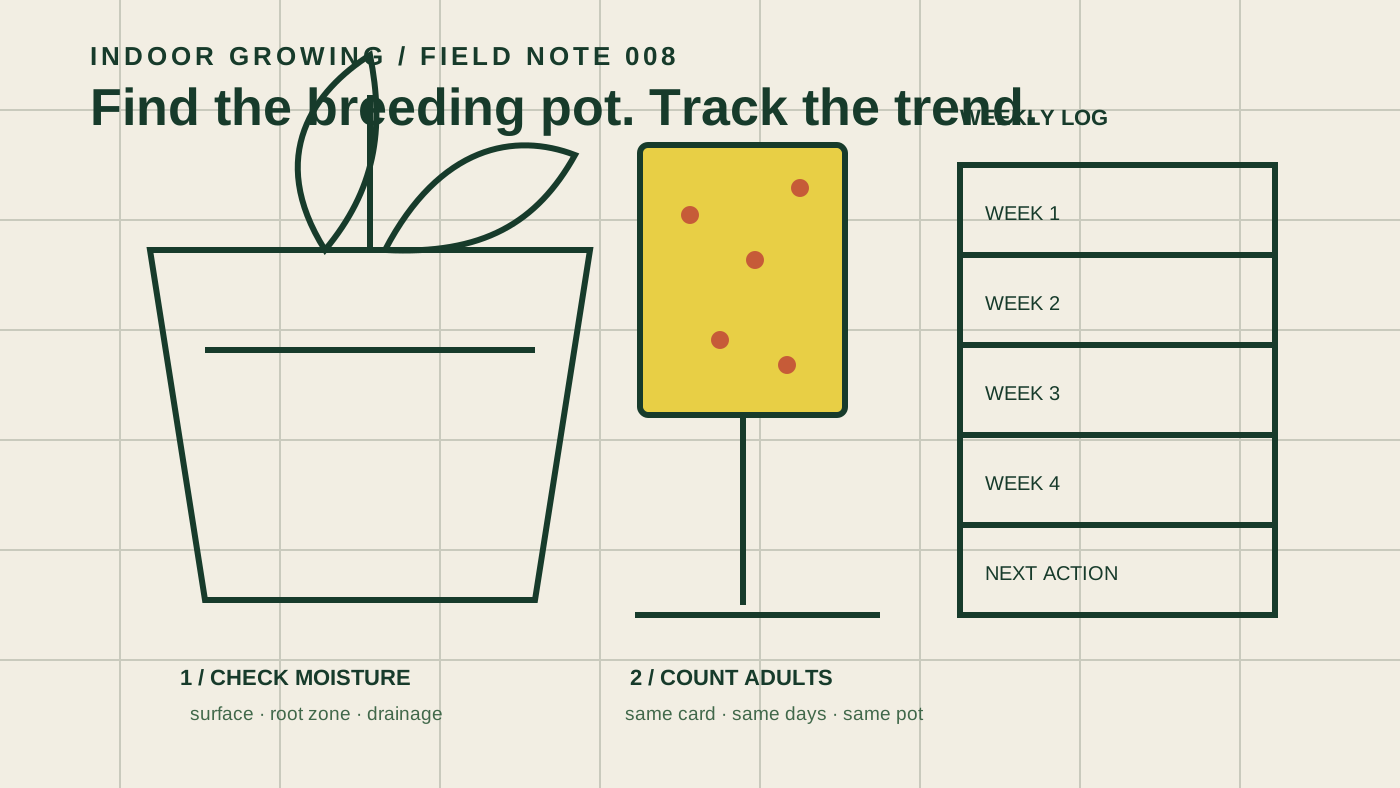
Place a yellow sticky card close to the media without touching foliage. Label the card with the pot name and start date. University of Minnesota Extension recommends sticky cards to detect adults but warns that traps should not be the only management method. The purpose is to locate activity and track direction, not to declare success from one crowded card.
To check for larvae, UC IPM and University of Minnesota Extension describe placing a raw potato piece cut-side down on the media. Check the underside after a few days for translucent, wormlike larvae with dark head capsules. Remove the slice before it decays, record the result and dispose of it. Keep food-allergy and household hygiene needs in mind when using any food as a monitor.
Why late fall and winter expose the problem
Colorado State University Extension notes that nuisance fungus gnat problems are often most noticeable in late fall and winter. Plants brought indoors may carry populations with them, people spend more time inside, and shorter days slow plant growth and water use. If the summer watering calendar continues unchanged, potting media can remain wet longer.
Adults lay eggs in moist growing media. Larvae live mainly in the upper portion of the mix, feeding on fungi, algae and decaying organic matter; high populations can also feed on roots. Established houseplants often experience nuisance more than injury, but seedlings and young plants have smaller root systems and less margin. UC IPM reports that heavy populations can stunt growth and damage roots, especially in young plants.
The complete cycle can continue indoors. Colorado State describes development from egg to adult in roughly three to four weeks at typical room temperatures, which is why a few days without visible adults is not proof that the infestation ended. Monitor across at least one complete cycle after changing the conditions.
Map the wet zone instead of watering by the calendar
“Let it dry” is useful only when translated for the plant, pot and mix. UC IPM recommends allowing the surface to dry between waterings, avoiding overwatering and providing good drainage. Colorado State emphasizes drying the top 1 to 2 inches. That does not mean every crop should become bone-dry through the root ball.
- Record the last watering. Note top or bottom watering, approximate volume and whether water drained freely.
- Check more than the surface. Compare the top inch with the root zone using pot weight, a clean wooden skewer or the crop-appropriate moisture check.
- Inspect the exit path. Confirm drainage holes are open and remove standing water from saucers, cachepots and propagation trays.
- Look for retained moisture. Oversized pots, compacted mix, decomposed media, blocked drainage and low winter light can all slow drying.
- Water to the plant’s need. Replace a fixed weekday schedule with a trigger based on the crop and measured media condition.
- Log dry-down time. If the pot stays wet far longer than comparable plants, correct the container or media problem rather than stretching the interval indefinitely.
Bottom watering can keep the surface drier in some setups, but it does not guarantee that a pot is unsuitable for gnats. Adults may reach drainage openings and chronically wet media still supports the biology. Use the bottom-watering calibration to control volume and soak time, then drain the tray fully.
Remove the resources that keep larvae fed
Clear dead leaves, fallen flowers, algae, spilled organic fertilizer and decaying roots from the surface and saucer. Fix irrigation leaks and standing water nearby. UC IPM advises against incompletely composted organic matter in potting media and notes that excessive manure, blood meal or similar organic materials can favor the habitat.
Keep unused pasteurized potting mix closed, dry and off the ground. A torn open bag in a damp garage or plant room can become a reservoir for pests. Do not bring garden soil indoors as container mix. When a mix has collapsed and remains saturated, repotting may be warranted—but changing every pot at once adds plant stress, work and another opportunity to spread insects.
Repot a severely affected or structurally failed container into clean, suitable media and a cleaned pot. Remove as much old mix as the plant safely tolerates, following crop-specific guidance. Do not reuse suspect mix for seedlings. The four-bin potting-mix triage explains when to discard, downgrade or trial old media.
Use one monitoring card per problem area
A sticky card is most useful when its placement and counting interval stay consistent. Place it at media height near the suspected pot, label it, and count on the same weekday. Replace it when crowded, dusty or no longer sticky, recording the old total before removal.
| Signal | What it can tell you | What it cannot prove |
|---|---|---|
| Adults on yellow card | Relative activity near that location | Exact number of larvae or plant damage |
| Larvae under potato slice | Larvae are present in that pot | That every nearby fly came from it |
| Wet surface for days | Breeding conditions may persist | That watering is the only source |
| Counts declining weekly | The combined plan may be working | That the life cycle is already finished |
| One zero count | No adults captured in that interval | Eradication |
If several pots share a shelf, use separate labeled cards or a short isolation test to identify the source. One trap across a room cannot distinguish a wet propagation tray from a mature container. Keep cards out of reach of children and pets and away from fans that can distort the comparison.
When a labeled control is needed, target the correct life stage
Moisture and sanitation are the base of the plan. When populations persist or seedlings are at risk, UC IPM lists biological controls that target larvae, including Bacillus thuringiensis subspecies israelensis (Bti) and the entomopathogenic nematode Steinernema feltiae. These are not interchangeable ingredients or blanket “natural” remedies.
Read the full product label before purchase and again before use. The label must allow the exact pest, plant or growing site and application method. UC IPM notes that the Bt subspecies labeled for caterpillars is not effective against fungus gnat larvae. Bti does not persist indefinitely indoors, so repeated label-directed applications may be required. Living nematodes are perishable and depend on correct species, storage, temperature and moisture.
Sticky cards target adults; soil drenches target larvae. That difference explains why one tactic often reduces nuisance without ending reproduction. Do not aerially fog a room or spray gnats in flight. UC IPM says insecticides are rarely warranted for these flies in homes and advises label-directed, site-specific use when a pesticide is chosen.
- Do not pour household disinfectants, peroxide mixtures, essential oils or soap recipes into media unless the exact product label authorizes that use.
- Do not apply a pesticide to edible herbs or seedlings unless the label permits the crop, indoor site and harvest interval.
- Do not scatter abrasive dusts where people or pets can inhale them.
- Do not cover a pot with an untested layer that blocks inspection, airflow or irrigation.
- Do not bake occupied potting mix in a kitchen oven; clean replacement media is the clearer small-project control.
Protect seedlings without keeping them dry
Seedlings need even moisture, so withholding water until wilting is not a sound pest plan. Reduce standing water, improve airflow around—but not directly blasting—the tray, use clean media and containers, and remove weak or collapsed seedlings promptly. Keep propagation tools and benches clean so larvae and contaminated debris do not move between trays.
Covering a clean flat with fine mesh can reduce egg-laying exposure in production settings, according to UC IPM, but the cover must still support ventilation, light and daily inspection. For home seed starting, sanitation, measured watering and early monitoring are usually the simplest controls. Start with the frost-date seed calendar so indoor tray capacity does not exceed the space you can light, inspect and drain.
If seedlings are stunted, yellowing or collapsing, do not assume fungus gnats are the sole cause. Damping-off, salts, poor temperature, weak light and waterlogging can look similar. Check the full environment and seek a diagnostic lab or Extension office when the crop matters.
Print the four-week fungus gnat log
Fungus gnat monitoring card
Plant / location
Pot / media
Card start date
Watering trigger
Drainage check
Potato check
| Week | Adult count | Surface / root moisture | Water + drainage | Action |
|---|---|---|---|---|
| 1 | ||||
| 2 | ||||
| 3 | ||||
| 4 |
Trend, plant response and next action
Keep counting for a full life cycle after the last major change. A downward trend across consistent intervals is more useful than one clean card. If counts stay flat, look for a missed wet pot, a propagation tray, an open bag of mix, a drain or another source outside the plant collection.
Reader questions, answered
Are fungus gnats harmful to people?
Adults do not bite. They are mainly a nuisance indoors. High larval populations can injure roots, with seedlings and young plants at greater risk.
Will yellow sticky traps get rid of them?
Traps capture adults and help measure activity, but they do not directly control larvae. Pair monitoring with corrected moisture, sanitation and a label-directed larval control when needed.
Should every infested plant be repotted?
No. Start with identification, drainage and moisture correction. Repot when media is structurally failed, contaminated or cannot dry appropriately, or when a crop-specific plan calls for it.
How long does control take?
Expect to monitor across several weeks because eggs, larvae and pupae may remain after adult numbers fall. The exact time depends on temperature, media moisture, source control and the treatment label.
Sources checked
- University of California Statewide IPM Program — Fungus Gnats
- University of Minnesota Extension — Managing insects on indoor plants
- Colorado State University Extension — Fungus Gnats as Houseplant and Indoor Pests
- UC IPM — Fungus Gnats in Floriculture and Ornamental Nurseries
- Penn State Extension — Pest and Disease Problems of Indoor Plants
Research reviewed November 14, 2026. Public discussions were used to identify recurring questions about sticky cards, watering, repotting, Bti, nematodes and unverified home remedies. Recommendations were resolved against current Extension and IPM guidance and must be checked against the exact pesticide label.